How to care for Eleggua this Monday: plan it here
Your Monday with Eleggua
How will you care for Eleggua this Monday?
Tell us whether you have already received Eleggua or would like to honour him without being initiated, and what you need this week. We’ll put together your Monday routine, his prayer and the candle that suits you best.
What’s your situation?
What do you need this week?
Choose your situation and what you need.
What does it mean to have an Eleggua?
In Santería, or Regla de Ocha, ‘having an Eleggua’ means having received him. It is not a figure you buy: it is a consecrated representation of the orisha, handed over in a ceremony by a santero or santera, your godfather or godmother. It is usually a stone called an otán or a cement head with eyes and a mouth made of cowrie shells, and it lives in a clay dish behind the front door.

Eleggua is usually received together with the other Warriors: Ogun, Ochosi and Osun. For many, this is their first step into the religion, and he is received before any other orisha because Eleggua is the one who opens the way for all the others. In the Ifá tradition, babalawos hand over Eshu, his more streetwise and impetuous companion.
Honouring Eleggua without having received him is a different matter: all it takes is a candle, a prayer and a simple offering. That is within reach of anyone who approaches him with respect. If you’d like to get to know him in depth, we explain who Eleggua is, how he is represented and what his colours symbolise.
Eleggua belongs to a living religious tradition. Here we share how he is honoured in popular devotion; if you practise the religion, always follow the guidance of your godfather or godmother.
Benefits of having an Eleggua
According to tradition, these are the main benefits of having an Eleggua at home:
- He protects the home. He lives behind the door and keeps watch over who and what comes in: he is the guardian of the threshold.
- He opens roads. He helps get things moving when they are stuck: work, projects, paperwork and opportunities.
- He brings clarity to your decisions. He is the master of the crossroads, and people ask him for light when they don’t know which road to take.
- He carries your requests. As the messenger of the orishas, he takes your offerings and your prayers to the others.
- He warns you. Many people feel that Eleggua alerts them to what is coming, through signs or through their intuition.
- He is the foundation of the spiritual path. Receiving him together with the Warriors prepares you for the next steps in the religion.
These benefits are not automatic: they depend on the bond you build with him and the attention you give him. With Eleggua, consistency and gratitude count as much as the request itself.
Is it bad to have an Eleggua at home?
No. Having an Eleggua is not bad; quite the opposite, he is a form of protection. What it does involve is a commitment: he needs to be cared for regularly, usually every Monday, and treated with respect. Tradition says that a neglected Eleggua turns mischievous and things start to get stuck, just as they open up when he is well looked after.
What is not advisable is to ‘load’ an Eleggua figure yourself or to treat a decorative image as if it were a consecrated Eleggua. If in doubt, ask a santero or santera you trust.
Can I have an Eleggua if I’m not initiated?
Yes. Receiving Eleggua, usually as part of the Warriors, is precisely one of the first steps for those who are not yet initiated, which the religion calls being an aleyo. To do this, you need a godfather or godmother to give him to you and explain how to care for him.
And if you’d rather not take that step, you can still honour him: a red and black candle, a glass of water, a few sweets and a prayer on Mondays are a simple, respectful way to draw closer to him.
How to care for Eleggua at home on Mondays
Monday is Eleggua’s day. This is the most common routine, although every religious house has its own customs:
- Clean his space. Remove the old offerings and clean the corner behind the door.
- Greet him first, before any other orisha, with a ‘Laroyé!’
- Refresh him with a little cool water. Many santeros blow cigar smoke over him or spray him with aguardiente (cane spirit); only do this if your godparent has told you to.
- Offer him something he likes: sweets, sweet treats, toasted corn or a piece of fruit.
- Light his candle to one side, not on top of the offering, and say his prayer.
- Ask and give thanks. Speak to him sincerely, as you would to a wise child, and thank him.
Where do you put Eleggua in the house?
Behind the front door, low down and on a clay dish. From there he watches over the threshold between the street and the home. His candle goes to one side, somewhere safe, and is never left unattended.
What Eleggua likes: his offerings
Eleggua has the soul of both a child and an old man, and it shows in what he likes:
| Type | What he’s offered |
|---|---|
| Sweet things | Sweets, sweet treats and goodies: his favourites |
| Fruit | Coconut, guava and other sweet fruit |
| Food | Toasted corn and, in the tradition, smoked fish and hutia with corojo butter (red palm oil) |
| Drink | Cool water; in the tradition, a spray of aguardiente (cane spirit) and cigar smoke |
| Objects | Small toys (balls, whistles, kites), keys and coins |
| Colours | Red and black |
Each road of Eleggua has its own likes and taboos, so if you have received him, ask your godparent what yours should be given. Always remove the offering before it spoils.
Signs that your Eleggua is happy
According to tradition, when Eleggua is well cared for, things flow: opportunities appear, paperwork gets unstuck and you feel clearer when making decisions. Many people also notice it in his candle, which burns brightly and without sputtering. On the other hand, when everything gets stuck for no reason, it is said that Eleggua is asking for attention.
Prayer to Eleggua for Mondays
The Eleggua prayer candle comes with his traditional prayer. If you’d like to add your own words, you can say this one every Monday:
Eleggua, master of the roads and guardian of my door,
today, Monday, I greet you first. Laroyé!
Open the roads that are meant for me
and close those that bring me no good.
Watch over my home and all who live in it,
give me clarity to decide
and carry my requests to the orishas.
Thank you for walking beside me. So be it.
To give him thanks
‘Eleggua, thank you for opening my road and for walking by my side. What you give me I receive with joy, and I share it. Laroyé!’
Which candle to light for Eleggua
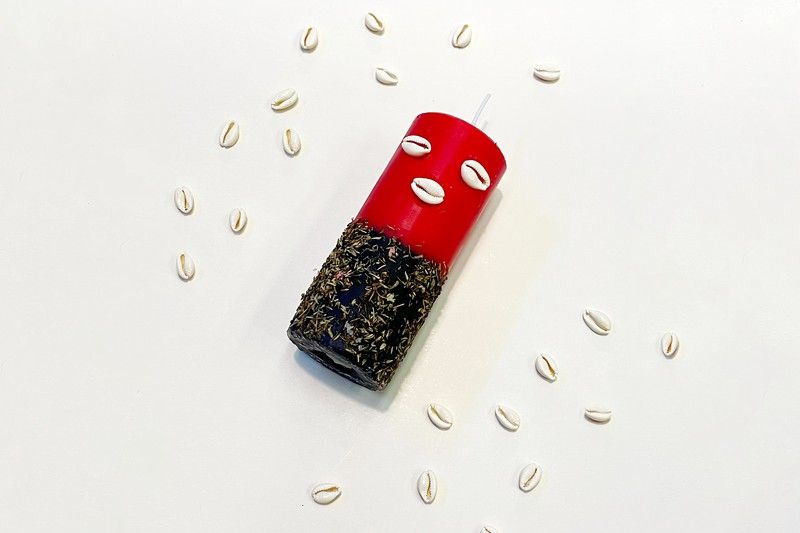
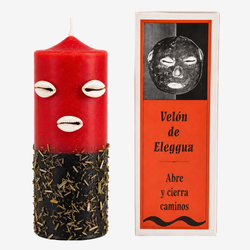
Eleggua’s candle bears his colours, red and black. These are ours, handmade in our workshop in Mataró:
| Candle | Description | Ideal for |
|---|---|---|
| Prepared Eleggua candle€16.95 | Red and black ritual candle, prepared to open and close chapters | An important request or closing a chapter |
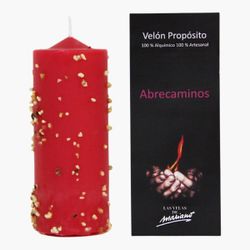
| Eleggua prayer candle€5.90 | Eleggua ritual candle with his prayer | Caring for him every Monday |
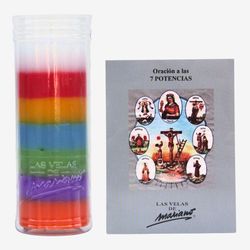
| 7 African Powers prayer candle€8.80 | Eleggua alongside the rest of the Seven African Powers | Asking for help on several fronts at once |
If what you need is a complete ritual to clear your path, take a look at our road-opening rituals and our guide to the 7 African Powers candle.

Eleggua at a glance
If you’d like to know which saints he is identified with, what his roads are or how he differs from Eshu, we explain it all in our guide to who Eleggua is.
Frequently asked questions about having an Eleggua
What does it mean to have an Eleggua at home?
It means having received Eleggua’s consecrated representation from a godfather or godmother (usually a stone, known as an otán, or a cement head with cowrie-shell eyes). He lives behind the front door, where he protects the home and opens the roads of the person who keeps him.
What are the benefits of having an Eleggua?
According to tradition, he protects the home, opens roads and opportunities, brings clarity to decisions, carries requests to the other orishas and warns of what is coming. The benefits depend on the care and respect he is given.
Is it bad to have an Eleggua at home?
No. He is a form of protection, but having him means committing to care for him regularly, usually every Monday. Tradition says that a neglected Eleggua makes things get stuck.
Which day do you care for Eleggua?
Monday, which is his day. You greet him first, before any other orisha, refresh him, offer him something he likes and light his candle.
What does Eleggua like?
Sweets and sweet treats, coconut, guava, toasted corn, small toys and keys. In the tradition he is also offered smoked fish and hutia, a spray of aguardiente (cane spirit) and cigar smoke. His colours are red and black.
Where do you put Eleggua in the house?
Behind the front door, low down and on a clay dish. From there he watches over the threshold between the street and the home. His candle goes to one side, somewhere safe.
Can I have an Eleggua if I’m not initiated?
Yes. Receiving Eleggua, usually together with the Warriors, is one of the first steps for anyone who is not initiated. You need a godfather or godmother to give him to you. If you don’t want to take that step, you can honour him with a candle, a prayer and a simple offering.
Key takeaways
Having an Eleggua means having a guardian at your door and a companion at every crossroads. Care for him every Monday, speak to him with affection and give him thanks: that is how the roads open.




Our customers trust us
Opinions of our clients
Receive our news