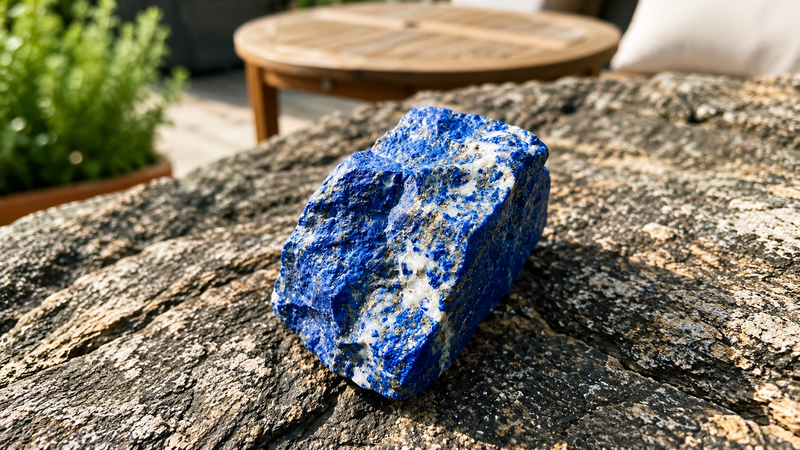
What if I told you blue was worth more than gold?
Hundreds of years ago, getting hold of a deep, intense blue was far from easy. In fact, it was one of the most expensive colours there was.
The reason? It came from a mineral called lapis lazuli, a stone of profound blue that was already treasured in Ancient Egypt and in the civilisations of the Middle East, where it was used to make jewellery, amulets and ceremonial objects.
What "lapis lazuli" means
Its name has a story too. "Lapis" means stone in Latin, while "lazuli" comes from an old Arabic word (lāzaward, inherited from Persian) that referred to the blue of the sky. In other words, lapis lazuli could be understood as "the stone of the sky" or "the blue stone".
The ultramarine of the Renaissance
Over the centuries, this mineral travelled thousands of kilometres from the mountains of Afghanistan to Europe, where Renaissance artists ground it down to make the famous pigment ultramarine.
It was so precious that it was only used for the most important parts of a painting.
Wisdom, calm and clarity
In time, new pigments appeared and blue stopped being a luxury. But lapis lazuli remained a much-loved stone, not only for its beauty but also for the symbolism many cultures have given it, linking it with wisdom, calm and mental clarity.
It's curious to think that a simple colour can hide so much history.
Next time you see a piece of lapis lazuli, perhaps you won't see just a blue stone. You'll see a small fragment of the history of art, of nature and of the civilisations that came before us.





Our customers trust us
Opinions of our clients
Receive our news